





Enterprise Local SEO Strategies for Managing 30+ Profiles


Sep 10, 2026

Contents
 14 min
- What Is Enterprise Local SEO?
- Why Local SEO Matters for Enterprise Expansion
- Which Businesses Need Enterprise Local SEO?
- Enterprise Local SEO vs Regular Local SEO
- 13 Strategies to Scale Enterprise Local SEO
- A Local SEO Checklist for Opening a New Enterprise Location
- Common Challenges When Scaling Across 50+ Locations
- Where Enterprise Local SEO Fits in Modern Search
- Optimizing for GEO & AEO
- Conclusion


I have always been interested in enterprise local SEO because it consistently delivered some of the strongest business outcomes for our clients.
A 2026 Local Consumer Review Survey from BrightLocal finds 97% of consumers read reviews for local businesses.
While many companies focus on national rankings, some of the most meaningful growth came from helping brands dominate local search visibility across dozens, hundreds, or even thousands of locations.
Businesses would invest heavily in content, paid media, branding, and website improvements, yet large portions of their potential customers still could not find them in local search results.
Once we addressed local visibility at scale, traffic improved, location-specific leads increased, and brand presence strengthened across multiple markets simultaneously.
Enterprise local SEO focuses on managing search visibility across a large network of locations, service areas, branches, franchises, or regional offices.
The challenge in enterprise SEO is maintaining consistency, authority, and discoverability across an entire location ecosystem.
What Is Enterprise Local SEO?
Enterprise local SEO is the practice of managing the local search visibility of multi-location firms while guaranteeing consistent branding, correct location information, scalable optimization, and high local relevance across all the markets served.
Enterprise local SEO is about managing visibility on a broader scale, whereas conventional local SEO is built around a single business location.
Watch this webinar to understand how crawlability connects to traffic and conversions on enterprise websites.
This is to ensure that when people are looking for local services, goods, or solutions inside a particular geographic area, they will be able to find all of the locations. Including optimization for your business profiles, local content, structured data, internal linking, etc.
Enterprise local SEO is critical for firms with locations in numerous cities, states, or countries. This is because search engines determine local relevance on a location-by-location basis.
Why Local SEO Matters for Enterprise Expansion
Enterprise firms frequently believe that simply having a strong domain authority will give them local visibility. However, in reality, local search operates differently.
Google uses local signals such as distance from the searcher, business relevance, and prominence/popularity.
These signals are separate from most standard SEO ranking variables. Having a well-optimized business website does not mean that you will be visible across all locations or markets.
That’s why enterprise local SEO matters so much. Without optimization for a particular place:
-
Locations become invisible
-
Leads are lost
-
Brand consistency weakens
-
Competitors gain local market share
The larger the organization becomes, the more important local search governance becomes.
Which Businesses Need Enterprise Local SEO?
Many organizations assume local SEO only matters for small businesses. That assumption could become expensive.
Several enterprise business models depend heavily on local search visibility, and here are some types of businesses that should never ignore local SEO.
1. Healthcare Organizations
Hospitals, clinics, urgent care centers, dental networks, behavioral health providers, and medical groups often operate across multiple locations. The main reason healthcare never ignores this issue is because patients search locally.
Even nationally recognized healthcare brands depend on local visibility to acquire new patients.
2. Franchise Businesses
Franchise systems face one of the largest enterprise local SEO challenges. Each franchise location requires:
-
Location visibility
-
Review management
-
Local content
-
Citation consistency
At the same time, brand consistency must remain centralized.
3. Financial Services
Banks, credit unions, wealth management firms, and insurance providers often maintain large branch networks.
Local visibility helps drive appointment requests, consultations, and customer acquisition for them
4. Retail Chains
Retail organizations rely heavily on local discovery. Consumers frequently search:
-
Store near me
-
Product availability
-
Store hours
-
Local inventory
Enterprise local SEO directly impacts foot traffic.
5. Home Services
Plumbing, HVAC, roofing, restoration, pest control, electrical, and home improvement companies tend to operate in various service territories.
Local search often drives a significant percentage of inbound leads.
6. Professional Services
Law firms, accounting firms, consulting organizations, and business service providers are increasingly aware that local visibility is key to capturing regional demand.
7. Automotive Groups
Dealership groups, service centers, and automotive franchises require strong location-level optimization to remain competitive in local search.
Enterprise Local SEO vs Regular Local SEO
Although the principles are similar, the execution is dramatically different.
|
Factor |
Regular Local SEO |
Enterprise Local SEO |
|
Number of Locations |
One or several |
Dozens to thousands |
|
Google Business Profiles |
Management constraint |
Profile management at a large scale |
|
Review Management |
Manual |
Centralized and automated |
|
Citation Management |
Basic |
Enterprise-level consistency |
|
Reporting |
Single location |
Multi-market reporting |
|
SEO Complexity |
Moderate |
High |
|
Content Strategy |
Localized |
Scalable and localized |
|
Governance |
Flexible |
Structured processes |
|
Technical Requirements |
Basic |
Advanced architecture and automation |
A single-location business can also improve their Google Business Profile manually, manage reviews, and optimize one location website.
But a corporate brand needs mechanisms that are standard throughout all branches, regions, franchises, and service areas.
For enterprises to make sure that every site can compete, they need centralized governance, consistent NAP data, scalable location page templates, automated reporting, review management protocols, and market-level performance tracking. This keeps branding consistent while ensuring each location’s details remain accurate and distinct.
13 Strategies to Scale Enterprise Local SEO
Enterprise local SEO scaling is a repeatable process to ensure every location is correct, discoverable, and locally relevant but also consistent with the brand across all areas.
Every plan should improve one of three things: how search engines view your locations, how customers discover the right branch or service area, and how your team manages local visibility at scale.
1. Prioritize Markets Before You Optimize Them
An enterprise with 500 locations that spreads resources evenly ends up doing a mediocre job everywhere instead of a strong job where it counts.
Market prioritization is the step that comes before the tactics below: deciding which locations get full investment first, which get the standard template, and which just need baseline compliance.
Score each location or market against a consistent set of factors:
-
Revenue potential: market size, addressable customer base, and average transaction value for that location.
-
Competitive gap: how strong local competitors already are in the map pack, based on their review volume and digital authority.
-
Current visibility gap: locations with incomplete GBP data, thin or missing location pages, or few reviews have the most room to gain and often the most to lose.
-
Search demand: local search volume for the categories that location serves.
-
Operational readiness: whether the local team, franchisee, or regional manager can actually execute and maintain changes once they make them.
-
Strategic priority: new openings, flagship locations, or markets tied to expansion plans.
Rank locations into tiers based on the combined score, then match the investment to the tier.
-
Tier 1 gets dedicated content, active review management, and local link building.
-
Tier 2 gets the standard template with periodic review.
-
Tier 3 gets automated compliance monitoring and nothing more until its score changes.
2. Manage Reviews at Scale with an AI Tool.
A strong review profile builds trust for each branch and rolls up into the reputation of the overall brand. At scale, the process needs a defined workflow, not ad hoc responses.
-
Request trigger: send a review request automatically after each completed visit, purchase, or service call, timed close to the experience while it's still fresh.
-
Response owner: assign a single role, whether that's the branch manager, a regional lead, or a central customer care team, to reply to reviews for each location so nothing sits unanswered.
-
Escalation path: route anything below a set star threshold, or any review mentioning a safety, billing, or service failure, to a central team within a fixed response window, such as 24 hours.
Google prohibits requesting specific review content. You may request genuine reviews, but you must not influence the rating or wording.
Google's guidelines prohibit incentivizing reviews or selectively soliciting only satisfied customers, a practice commonly called review gating, and violations can lead to reviews being removed or the profile being suspended.
3. Centralize Google Business Profile Management
Every location needs its own GBP listing, each with its hours, description, photos, and reviews. Manage them separately and errors creep in fast, especially past a few dozen locations.
-
Group every listing under a single Business Profile location group instead of a personal account. This lets you set access by role: give an agency partner Manager access at the group level, and give regional staff access limited to their own locations only.
-
If your brand has 10+ eligible stores/location sharing the same name and category, you're eligible for Google's bulk verification.
-
Bulk verification lets you verify the account once, so new locations matching your existing brand data are typically verified automatically instead of waiting on a postcard for each one. Bad or mismatched data can get bulk status revoked, so accuracy matters more once you're enrolled.
One exception is that service-area businesses, which have no walk-in address and deliver service at the customer's location, don't qualify for bulk verification. They must verify each listing individually, regardless of location count.
A local SEO platform such as BrightLocal, Yext, or Uberall can build on this structure to push updates to every listing at once and flag inconsistencies before they affect rankings.
Watch BrightLocal’s walkthrough on auditing and streamlining Google Business Profiles across multiple locations.
4. Detect and Report Local Listing Spam Across Markets
Guideline compliance for your listings only solves half the problem. Competitors and lead-gen operators can take over a market with keyword-stuffed business names, fake addresses, or duplicate listings designed to outrank your legitimate locations.
You can run a quarterly scan of the top local pack results in each of your markets. Look for listings using non-standard business names to insert keywords, addresses that don't match a real, staffed location, or duplicate profiles competing with yours.
When you find a violation, report it through Google's business redressal form rather than trying to out-content it. Clearing spam out of a market's can result in protecting the ranking your legitimate location has earned and keeps the local pack usable for customers.
5. Build Regional Authority Through Local Link Building
Local link building helps enterprise brands gain authority in each market they serve. Instead of just building generic backlinks to the main website, businesses should also build relevant links to regional hubs, city pages, service-area pages, and individual location pages.
Local link building for enterprise brands should be targeted to specific markets. A backlink from a trusted local publication, partner, or community organization can assist search engines in determining whether a specific location is relevant and trustworthy in that region.
6. Build an Internal Linking Structure for Location Pages
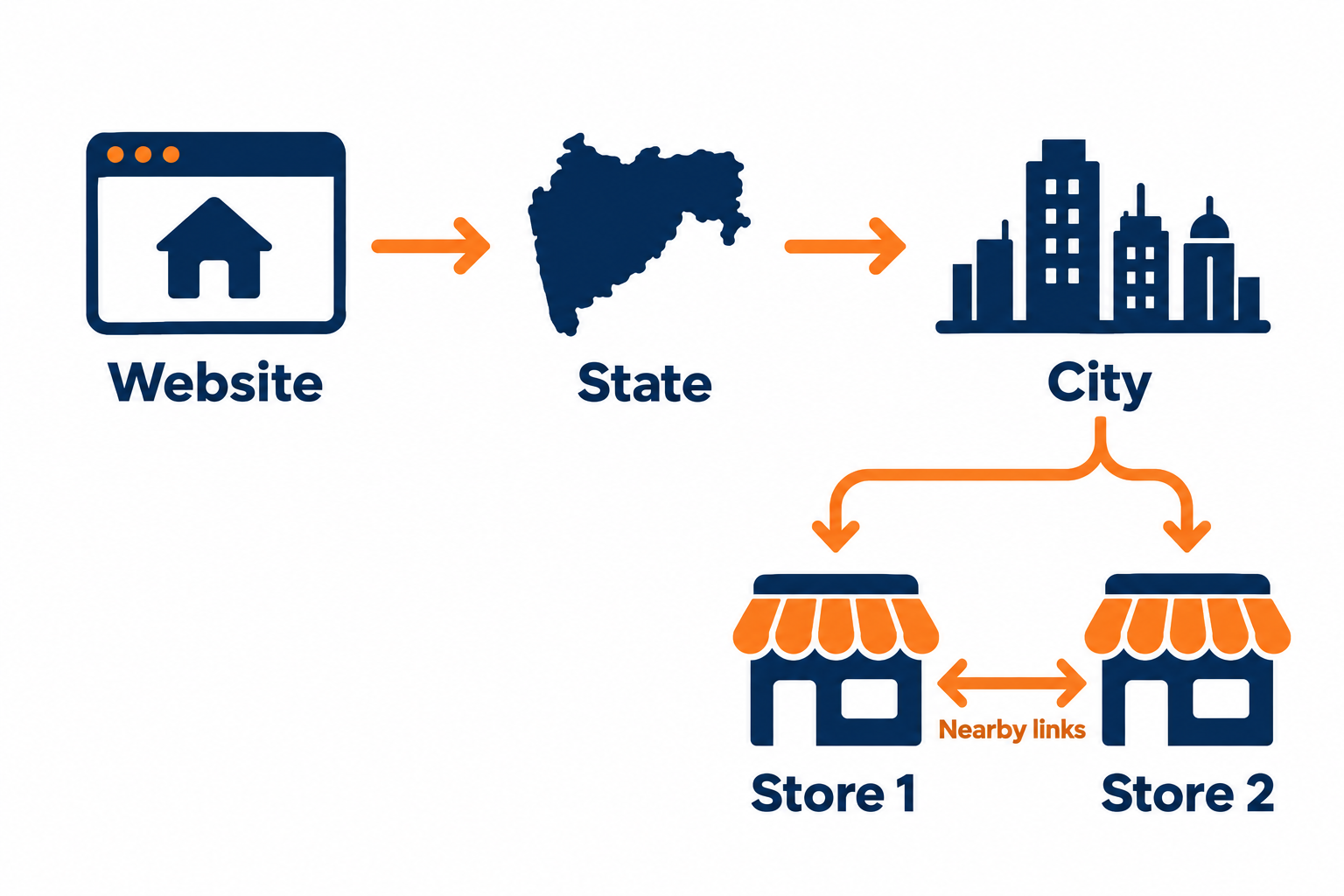
Create a Business Profile for every eligible, distinct location. Search engines use internal links to understand the relationship between places, services, regions, and neighboring branches.
Link each location page to:
-
Regional hubs
-
State pages
-
Service pages
-
Nearby locations
This improves crawlability and spreads authority across the location network.
7. Consistent NAP Information
NAP consistency helps search engines verify that each location is real and associated with the right local market. NAP means:
-
Name
-
Address
-
Phone Number
All company listings that follow NAP should have the same information across:
-
Google Business Profiles
-
Directories
-
Local citations
-
Location pages
-
Social profiles
Even small inconsistencies create confusion.
8. Monitor Spam and Guideline Compliance
For enterprise local SEO, you’ll also want to do regular spam and guideline-compliance checks. In many local markets, competitors often use keyword-stuffed business names, duplicate listings, fake addresses, incorrect categories, or misleading service-area information to get seen.
Look for duplicate/fake listings, wrong business categories, incorrect addresses or service areas, and policy violations on business profile relevance, distance, and prominence/popularity.
This helps to maintain local visibility and ensures that each location competes in a clean, compliant search environment.
9. Implement Local Business Schema
Local business schema markup gives search engines structured context about each location, what it is, where it operates, and how customers may discover it.
For corporate brands, this markup helps to reduce confusion across multiple branches.
services, and localized pages.
-
Locations
-
Services
-
Hours
-
Contact information
-
Geographic relevance
Schema improves machine readability and supports local visibility.
10. Create Location-Specific Content
Many enterprise brands have location sites, but they only provide basic address and service data.
Such information is not enough to show local relevance, especially when there are many places that offer the same services. You can support pages by adding:
-
City-specific guides
-
Community involvement
-
Regional service information
-
Local FAQs
-
Local case studies
This helps build credibility and can help in strengthening your website's ranking on search engines.
11. Monitor Local Rankings by Market
Enterprise local SEO reporting should not be based solely on national averages, as each market behaves differently.
A location may do well in one city, but another branch might struggle with visibility, reviews, or local pack presence. Track:
-
Market-specific visibility
-
Local pack presence
-
Review growth
-
Location traffic
-
Lead generation
-
Conversion performance
12. Use Automation Carefully
If you have hundreds or thousands of locations to manage, you need automation, but the goal of automation should be to improve consistency, not replace quality.
And bad automation can lead to thin pages, duplicate content, and inaccurate local data at scale. At an enterprise scale, automation is essential. But automation should complement quality, not replace it. Automate:
-
Citation management
-
Reporting
-
Data monitoring
-
Review tracking
Thin pages/content can harm your ranking; try to avoid it. Search engines increasingly prioritize quality over scale.
13. Reporting and ROI Attribution
Ranking reports alone don't answer the question that business leaders actually ask: whether local search produces revenue. Tag every link on every GBP listing (website, appointment booking, menu, or services) with UTM parameters specific to that source, for example, utm_source=google&utm_medium=organic&utm_campaign=gbp_website.
-
Feed that data into GA4 and segment it by source and campaign to see how much traffic and how many calls, bookings, or store visits the Business Profile drives compared to organic search or paid channels.
-
For many multi-location brands, Business Profiles drive a meaningful share of organic-attributed revenue, an insight rankings alone can't surface.
Report these results at the market level, not just in aggregate. A national increase in visibility can mask a market that's losing ground, and that detail is what turns local SEO reporting into a business tool instead of a vanity metric.
A Local SEO Checklist for Opening a New Enterprise Location
Use this checklist to put the strategies above into action for a single new location, from pre-launch through the first few months.
Before Opening
-
Confirm the location fits your current market-priority tier and gets the matching level of investment.
-
Create or claim the Google Business Profile under your existing location group; check bulk-verification eligibility if it's a physical, walk-in location.
-
Add NAP data that matches the website and citation sources exactly.
-
Build the location page: branch-specific services, accessibility details, parking, team, accurate hours, and an appointment or order link.
-
Add local business schema to the new page.
-
Link the new page to its regional hub, state page, and nearby locations.
-
Set up UTM-tagged links on the GBP listing for the website, appointment, and menu or services links.
At Launch
-
Verify hours, phone number, and address are live and match across GBP, website, and directories.
-
Publish an opening announcement on the Business Profile.
-
Turn on the automated review-request trigger for completed visits or purchases.
-
Confirm the location page and GBP listing are indexed and appearing in local search.
After Opening (First 90 Days)
-
Run a compliance check on the new listing: correct category, no duplicate profiles.
-
Scan the local pack in that market for competitor spam and report any violations.
-
Monitor rankings, review growth, and conversion performance for the market.
-
Reassess the location's priority tier once real performance data comes in, and adjust investment accordingly.
Common Challenges When Scaling Across 50+ Locations
Ensure that you maintain quality and consistency across all markets, as retaining local relevance can help improve your rank. To save trouble, here are some challenges that an enterprise can face while optimizing.
1. Duplicate Location Pages
Pages for different locations often contain little unique local information, leading to detrimental effects on relevance and worsening duplication issues.
2. Inconsistent Listings
Phone numbers are often incorrect, addresses are not current, there are duplicate listings, information is missing, or the business names do not match in large organizations.
This inconsistency creates uncertainty for search engines and dilutes local trust signals, resulting in poor search engine rankings.
3. Reporting Complexity
Enterprise organizations need visibility across hundreds of markets simultaneously.
Without structured reporting, local opportunities stay hidden.
Where Enterprise Local SEO Fits in Modern Search
Search continues to trend toward local intent. Location relevance matters for AI search platforms, Google Maps, local packs, mobile discovery, and conversational search.
National visibility alone is not enough for brands that depend on local customers.
Businesses that own local search tend to be better at brand awareness, capturing location-specific demand, and creating a more resilient acquisition system.
Local visibility is a compounding growth channel over time.
Optimizing for GEO & AEO
AI comes up with answers by linking trustworthy websites together. Use a three-part optimization framework to ensure that your business locations appear in the generated responses:
Unstructured Citation: Velocity is a priority; generative systems seek common ground across unstructured data footprints. This means that digital PR, mentions in local news, listings in area chambers of commerce, and contextually relevant features in local blogs are just as important as structured directories.
Optimize for Natural Language Long-tail Queries: Users query conversational engines in whole sentences (e.g., “Which [Brand Name] location near downtown Austin has parking and is open past 8 PM?”). Make sure your location landing pages directly address these long-tail, attribute-based queries with plain, scannable language snippets.
Encourage Authentic Customer Reviews: Request honest reviews after genuine customer experiences without suggesting ratings, keywords, or specific wording. For multi-location brands, establish a consistent review-request process across branches, monitor feedback centrally, and use recurring customer concerns to improve each location’s service.
Conclusion
Enterprise local SEO becomes valuable when every location can earn trust in its own market while still supporting the larger brand.
This necessitates more than just publishing location pages and updating listings; it necessitates a system that ensures local data accuracy, content usefulness, active reviews, and market performance visibility.
For enterprise brands, local search is a growth channel that compounds over time. When each location is simple to find, trust, and select, the brand gains greater visibility in every region it serves.



Your SEO, on autopilot
Saffron OS runs 15+ AI agents that audit your visibility across Google, ChatGPT, Gemini and Perplexity every day — then fix what's broken, automatically. Built over 18 months. Results in 2–15 minutes.
Explore Saffron OSFAQs
How do enterprise brands keep local pages unique across dozens or hundreds of locations?

Use a modular page template that pulls in location-specific details such as team bios, service areas, hours, inventory, case studies, and localized FAQs. Combine these elements with a central content system and clear ownership rules so each location can update its own unique content without breaking the template.
Why do enterprise local rankings drop even when the Google Business Profile looks fine?
A strong profile is not enough if the website pages, citations, reviews, and local landing pages are inconsistent. Local drops often happen because signals across the site and the profile stop matching, not because of one obvious error.
How do I manage duplicate listings and location data conflicts across multiple branches?
Treat location data as a governance issue by maintaining a single source of truth for hours, addresses, phone numbers, and URLs. Use a location-management platform or internal database to push updates to your site, GBP, and major directories from that one master record.
How do enterprise teams decide whether a keyword has local intent or national intent?
Check SERP features (local pack, map results, “near me” modifiers), competitor pages, and search-volume patterns by city or region. If results show local packs and location-specific pages, treat the keyword as local; if results are mostly national brands and generic pages, treat it as national.
How do I stop local page cannibalization across multiple city and store pages?
This usually happens when too many pages target the same service-and-location combinations with nearly identical content. The fix is less about adding more pages and more about defining which page should own each intent.
How do I know if local SEO is actually driving revenue and not just map visibility?
The important signal is whether local traffic leads to calls, bookings, store visits, or qualified leads. Map rankings matter, but they are only useful if they connect to measurable business actions.

Shreya Debnath

Shreya Debnath is a Marketing Manager at Saffron Edge with over 5 years of experience in SEO, AI-driven marketing, growth marketing, and technical SEO. She has hands-on expertise in optimizing existing content, improving performance, and driving scalable growth through data-backed strategies. She has worked with international markets, especially the US and UK, and diverse teams to build effective marketing campaigns, strengthen brand positioning, and enhance audience engagement across multiple channels. Her approach focuses on aligning sales and marketing to ensure consistent and measurable results. Outside of work, Shreya enjoys exploring new cities, pursuing creative hobbies, and discovering unique stories through travel and local experiences.
Related Blogs
We explore and publish the latest & most underrated content before it becomes a trend.



11 min read
.COM vs .ORG vs .NET vs .CO vs .IO – Which Domain Should you choose?
By Praveen Kumar

Subscribe to Saffron Edge Newsletter!


Your SEO, on autopilot
Saffron OS runs 15+ AI agents that audit your visibility across Google, ChatGPT, Gemini and Perplexity every day — then fix what's broken, automatically. Built over 18 months. Results in 2–15 minutes.
Explore Saffron OS